Abstract
Process mining provides techniques to extract process-centric knowledge from event data available in information systems. These techniques have been successfully adopted to solve process-related problems in diverse industries. In recent years, the attention of the process mining discipline has shifted to supporting continuous process management and actual process improvement. To this end, techniques for operational support, including predictive process monitoring, have been actively studied to monitor and influence running cases. However, the conversion from insightful diagnostics to actual actions is still left to the user (i.e., the “action part” is missing and outside the scope of today’s process mining tools). In this paper, we propose a general framework for action-oriented process mining that supports the continuous management of operational processes and the automated execution of actions to improve the process. As proof of concept, the framework is implemented in ProM.
Practical problem
Operations managers use process mining to spot bottlenecks, rule violations and late orders, but today’s tools stop at diagnostics: a report, a dashboard or a prediction. Turning those insights into concrete actions, such as reprioritizing an order, assigning more staff or alerting a case manager, is left entirely to people, and a one-off report quickly goes stale as conditions change. Operational support techniques can monitor running cases continuously, yet they do not say how the results should be acted upon, and commercial action engines do not handle streaming data or process-level interventions. The step from insight to automated improvement is missing.
Research questions
- How can process mining diagnostics on a continuously updated event stream be converted automatically into management actions executed by the information system?
- Does a constraint monitor detect violations in such a stream, and does an action engine generate the corresponding transactions?
- Does applying the generated transactions improve the operational process?
Contributions
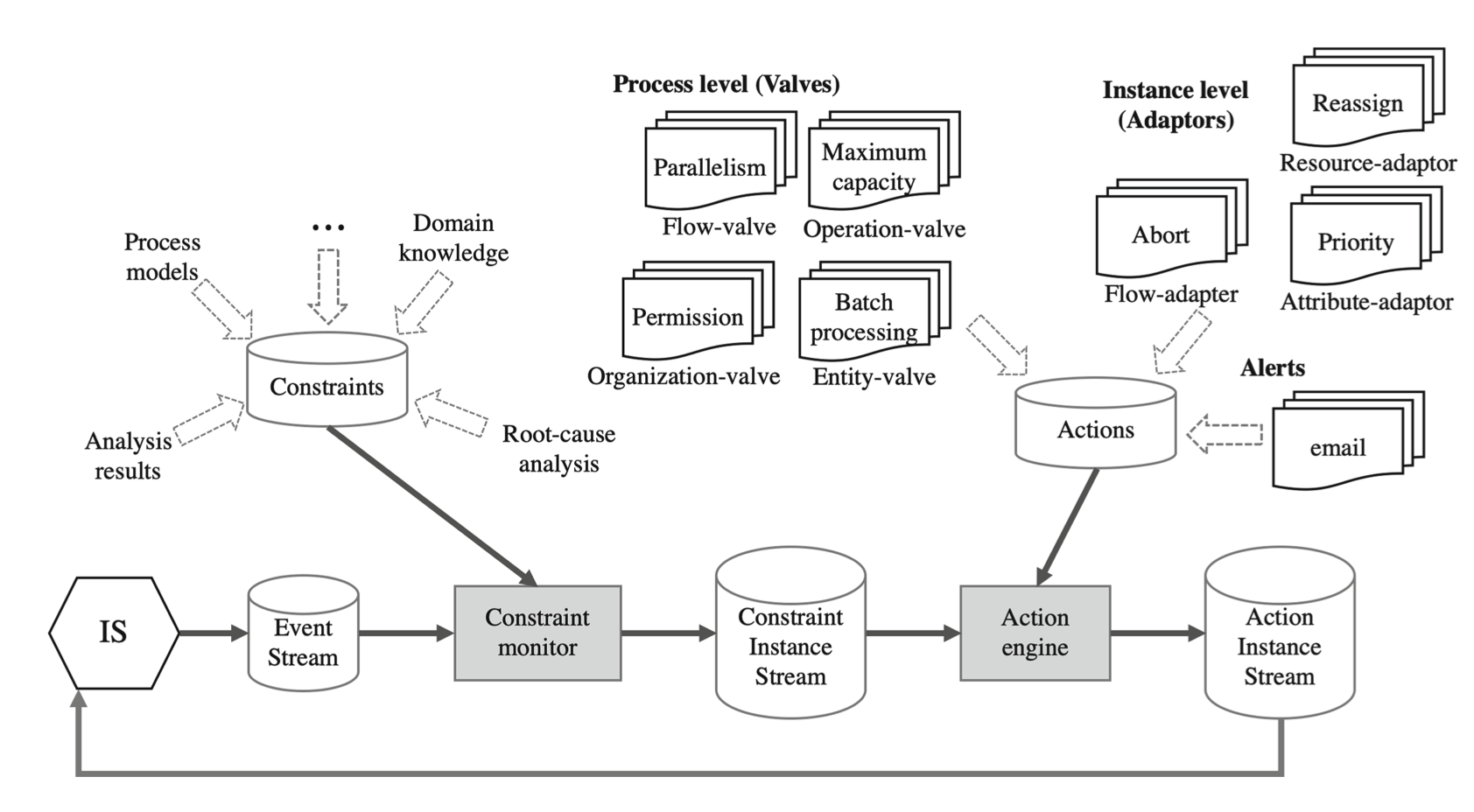
- A general framework for action-oriented process mining with two components: a constraint monitor that turns an event stream into a constraint instance stream, and an action engine that turns it into an action instance stream of transactions.
- Formalizes event streams over multiple object classes (a conventional event log being a special case), time windows, time moments, contexts, constraint formulas, constraints, transactions, action formulas and their instances.
- Distinguishes three kinds of actions: process-level valves, instance-level adaptors and alerts.
- A
ProMplug-in (package ActionOrientedProcessMining) with an XML-based Object-Centric Log format, a Constraint Formula Language, an Action Formula Language and an Action Instance Stream format, released on GitHub (gyunamister/ActionOrientedProcessMining). - A proof of concept with a simulated order handling information system and a gateway that translates action instances into system transactions.
Key findings
- In a simulated order handling system with 16 resources, the constraint ‘an order must be delivered within 72 hours’ is evaluated every 24 hours, and every one of 40 inspected orders whose delivery time exceeds 72 hours is detected by the constraint monitor.
- The action engine generates the priority-raising transaction for every violated order and the case manager notification whenever a violation lasts longer than 24 hours.
- Over a 30-day simulation, the number of violated instances is lower when the generated transactions are applied than when they are not.
- The evaluation is a proof of concept on an artificial system without quantified effect sizes; validation on real systems such as SAP or Salesforce and a taxonomy of constraints and actions are left as future work.