Abstract
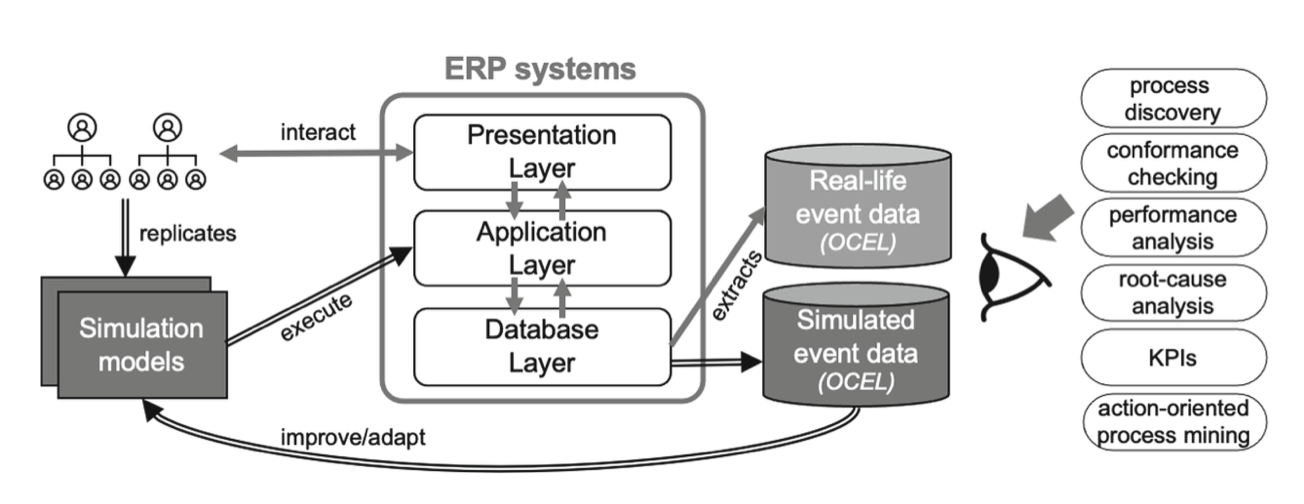
A digital twin of an organization (DTO) is a digital replication of an organization used to analyze weaknesses in business processes and support operational decision-making by simulating different scenarios. As a key enabling technology of DTO, business process simulation provides techniques to design and implement simulation models that replicate real-life business processes. Existing approaches have been focusing on providing highly flexible design tools and data-driven evidence to improve the accuracy of simulation models. Provided with such tools and evidence, business analysts are required to reflect comprehensive aspects of reality with subjective judgments, including the design of ERP systems and the organizational interaction with the system. However, given the complexity of ERP systems, it is infeasible and error-prone to manually incorporate the business logic and data restrictions of the system into simulation models, impeding the faithfulness and reliability of the following analysis. In this work, we propose a framework to integrate ERP systems in business process simulation to overcome this limitation and ensure the reliability of the simulation results. The framework is implemented in ProM using the SAP ERP system and CPN Tools.
Practical problem
Business analysts build simulation models to test what-if scenarios before changing a process, for instance adding staff or raising machine capacity, because experimenting on the real organization is costly or risky. The value of such a study depends on how faithfully the model reflects the enterprise system that runs the process, yet systems such as SAP enforce thousands of business rules and data restrictions (SAP alone can raise more than 2,821 distinct errors) that modelers would have to reproduce by hand. In practice models omit behavior the system requires or simulate behavior the system would reject, so the simulated event data and the conclusions drawn from them cannot be trusted. Analysts need a way to run simulations that respect the real system’s logic without re-modeling that logic themselves.
Research questions
- How can an ERP system be integrated into business process simulation so that its business logic and data restrictions are respected without being modeled in the simulation model?
- Does executing simulated behavior directly in the ERP system yield event data free of omission and commission problems that can be analyzed like real-life event data?
Contributions
- A framework with three components: an Enterprise Resource Planning (ERP) system abstracted as an object model updated by transactions, a simulation engine producing commands, and a transformation engine translating commands into executions.
- Formal definitions of object models, transactions, executions, commands, transaction mappings and parameter mappings that underpin the integration.
- An implementation using SAP ERP ECC 6.0 as the system, CPN Tools (Colored Petri Nets) as the simulation engine, and a
ProMplug-in (ERPSimulator package) that converts XML commands into SAP Remote Function Calls. - A proof of concept that simulates three order-to-cash scenarios (low conversion rate, manual price changes, order cancellations), with CPN files, commands and a manual released on GitHub.
Key findings
- Across the three scenarios, all 288, 4,249 and 4,540 generated commands are translated into Remote Function Calls and executed in SAP without errors, creating 286, 4,093 and 4,384 objects of up to 8 object types.
- In the low-conversion scenario, 34 of 73 quotations become orders (46.6%) and every quotation answered later than 10 days is rejected, a pattern recovered from the simulated data with the Inductive Visual Miner in
ProM. - In the price-change scenario, 113 of 402 orders need manual price changes (79% of the 138 orders containing product P-109); in the cancellation scenario 97 orders are canceled, most often for a delivery date set too late.
- The framework assumes a one-to-one mapping between simulated activities and ERP transactions, resolved manually in the implementation; many-to-many relationships and a feedback loop from simulated data to the simulation model remain future work.