Abstract
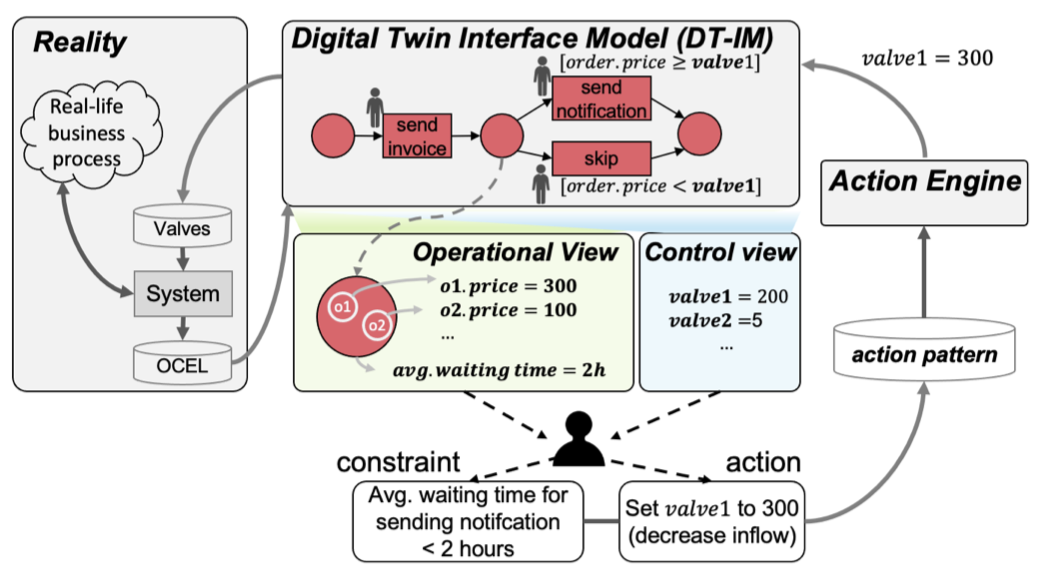
A Digital Twin of an Organization (DTO) is a mirrored representation of an organization, aiming to improve the business process of the organization by providing a transparent view over the process and automating management actions to deal with existing and potential risks. Unlike wide applications of digital twins to product design and predictive maintenance, no concrete realizations of DTOs for business process improvement have been studied. In this work, we aim to realize DTOs using action-oriented process mining, a collection of techniques to evaluate violations of constraints and produce the required actions. To this end, we suggest a digital twin interface model as a transparent representation of an organization describing the current state of business processes and possible configurations in underlying information systems. By interacting with the representation, process analysts can elicit constraints and actions that will be continuously monitored and triggered by an action engine to improve business processes. We have implemented a web service to support it and evaluated the feasibility of the proposed approach by conducting a case study using an artificial information system supporting an order handling process.
Practical problem
Organizations must keep improving processes such as order handling, but with tens of thousands of process variants running on systems like SAP ERP, analysts struggle to see the current state of a process, decide which corrective action to take, and apply it in time. Digital twins promise a live mirror of reality, yet concrete realizations exist only for physical assets such as vehicles and production lines, not for improving business processes across an organization. Monitoring techniques can detect delays and rule violations, but they stop at diagnostics and leave the configuration of the information system to be changed by hand. Process owners need a representation that shows both the state of the process and the levers available in the system, and a mechanism that pulls those levers automatically when a problem recurs.
Research questions
- How can a digital twin of an organization be represented so that it exposes both the current state of a business process and the configurable options of the supporting information system?
- How can process analysts turn recurring problems into action patterns whose constraints are monitored and whose actions are triggered automatically?
- Is it feasible to realize such a digital twin with action-oriented process mining on a running information system?
Contributions
- A digital twin interface model (DT-IM) formalized as an object-centric Petri net extended with valves (configurable system parameters) and guards encoding routing and resource allocation rules.
- Formal definitions of the operational view (marking, object values, diagnostics) and the control view (configurations and actions), together with an operation engine and an action engine.
- Taxonomies of constraint violations (compliance- versus performance-oriented) and management actions (inflow, routing, resource allocation, capacity) to support eliciting action patterns.
- A containerized web service (
dtween, on GitHub) that builds DT-IMs from Object-Centric Event Log (OCEL) data, updates states by token-based replay, visualizes them, and evaluates action patterns. - A proof-of-concept case study with a publicly available artificial information system that supports an order handling process with 14 resources.
Key findings
- A DT-IM of the order handling system is discovered from an OCEL; the operational view reports a 16-hour average sojourn time for send notification and a 0.3 routing probability for check availability with approval over two days.
- Two action patterns (skip more notifications when the two-day average sojourn time exceeds 16 hours, skip fewer when it falls below 10 hours) are evaluated every 12 hours over 24 days of streaming events in May 2021.
- Action A1 fires on 6, 18 and 25 May 2021 and sets the sn-price valve to 220, after which the sojourn time falls until the relaxed constraint triggers A2, which resets it to 180.
- With actions, the average sojourn time at 12:00 on 10 May 2021 is 9 hours versus 20 hours without actions.
- The evaluation uses an artificial system only; applicability to real-life information systems, real-time state updates, and inter-effects between actions remain unevaluated.