Abstract
Performance analysis in process mining aims to provide insights on the performance of a business process by using a process model as a formal representation of the process. Existing techniques for performance analysis assume that a single case notion exists in a business process (e.g., a patient in healthcare process). However, in reality, different objects might interact (e.g., order, delivery, and invoice in an O2C process). In such a setting, traditional techniques may yield misleading or even incorrect insights on performance metrics such as waiting time. More importantly, by considering the interaction between objects, we can define object-centric performance metrics such as synchronization time, pooling time, and lagging time. In this work, we propose a novel approach to performance analysis considering multiple case notions by using object-centric Petri nets as formal representations of business processes. The proposed approach correctly computes existing performance metrics, while supporting the derivation of newly-introduced object-centric performance metrics. We have implemented the approach as a web application and conducted a case study based on a real-life loan application process.
Practical problem
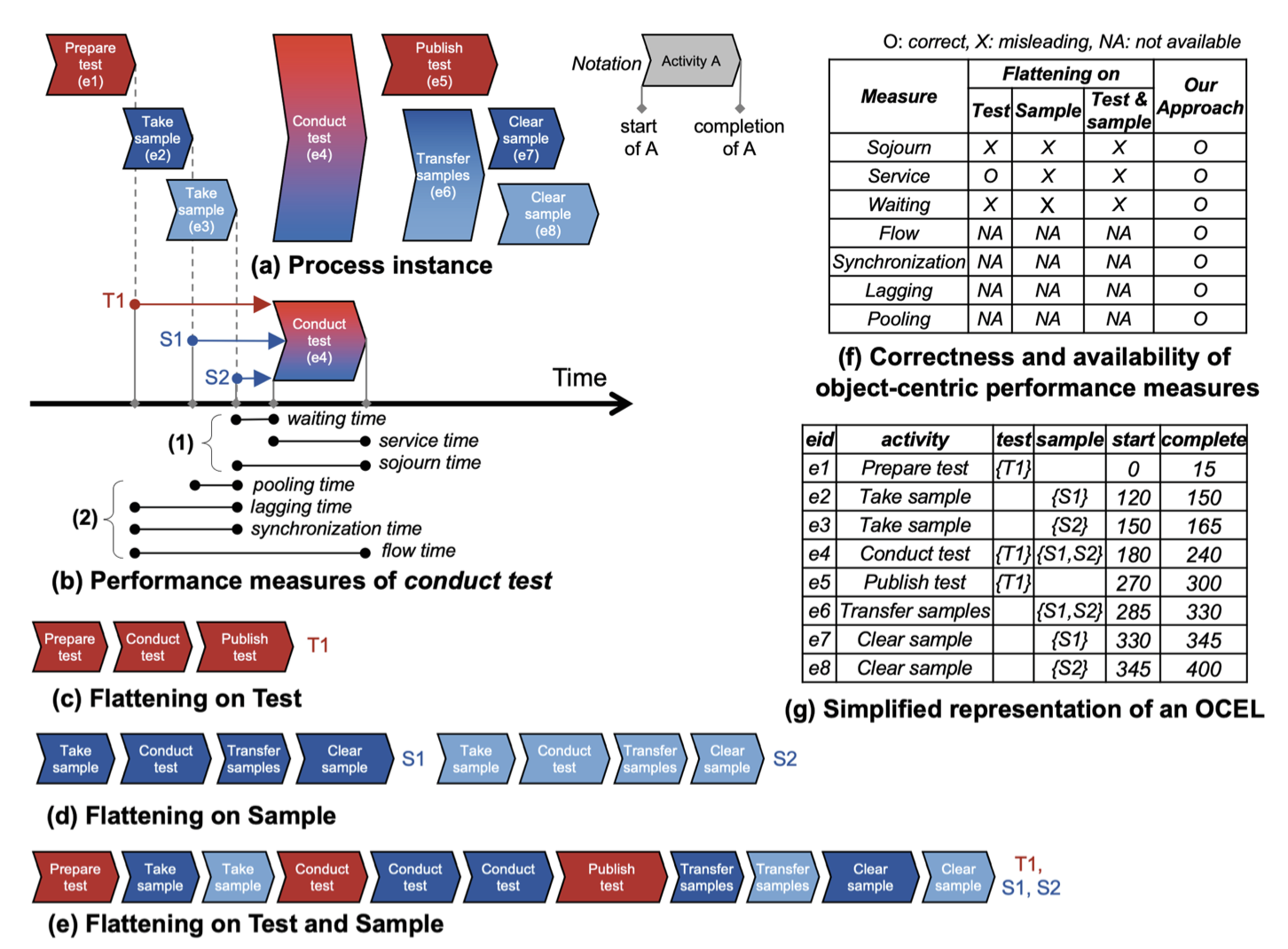
Process analysts measure where time is lost by replaying event data on a process model and reading off waiting, service and sojourn times. These techniques assume every event belongs to exactly one case, but in processes run on systems such as SAP an order, several deliveries and invoices interact and share events. Forcing such data into one case notion duplicates or drops events, so the reported frequencies and durations are simply wrong, and the time spent waiting for several objects to come together cannot be measured at all. Analysts may therefore chase the wrong bottleneck.
Research questions
- How can existing performance measures such as waiting, service and sojourn time be computed correctly when process instances involve several interacting object types?
- Which new performance measures capture the interaction between objects, and how can they be computed on object-centric Petri nets?
Contributions
- An approach that discovers an object-centric Petri net (OCPN) from an object-centric event log (OCEL), replays the log to obtain event occurrences and token visits, and computes performance per event occurrence.
- Formalizes replay (event occurrences, token visits) and the relation between an event occurrence and the latest token visit of each object it involves.
- Seven measurement functions: flow, sojourn, waiting and service time plus the object-centric synchronization, pooling and lagging time.
- A web application implementation (
OPerA, on GitHub at gyunamister/OPerA) with demo video and manuals. - A case study on the BPI Challenge 2017 loan application log with application and offer object types.
Key findings
- On the filtered loan log (20,478 events, 1,682 applications, 3,573 offers), the flattened analysis with Inductive Visual Miner in
ProMreports Send repeated by 1,799 applications with average sojourn about 2 days 23 hours, whereas the object-centric view shows it once per offer (92 offers skip it) with about 15 minutes. - Flattening counts Cancel application 1,891 times with average sojourn about 12 days 22 hours; the object-centric analysis yields 1,682 occurrences, once per application, with about 31 days 22 hours.
- The new measures show Cancel application has an average synchronization time of about 4 days 11 hours; lagging time is 3 days 15 hours for applications and 19 hours for offers, and pooling time of offers nearly equals synchronization time, so the second offer arrives about 4 days 11 hours after the first.
- Limitation: results depend on the quality of the discovered model, and non-conforming behavior can yield misleading insights; model-independent analysis is left to future work.