Abstract
Several decision points exist in business processes (e.g., whether a purchase order needs a manager’s approval or not), and different decisions are made for different process instances based on their characteristics (e.g., a purchase order higher than e500 needs a manager approval). Decision mining in process mining aims to describe/predict the routing of a process instance at a decision point of the process. By predicting the decision, one can take proactive actions to improve the process. For instance, when a bottleneck is developing in one of the possible decisions, one can predict the decision and bypass the bottleneck. However, despite its huge potential for such operational support, existing techniques for decision mining have focused largely on describing decisions but not on predicting them, deploying decision trees to produce logical expressions to explain the decision. In this work, we aim to enhance the predictive capability of decision mining to enable proactive operational support by deploying more advanced machine learning algorithms. Our proposed approach provides explanations of the predicted decisions using SHAP values to support the elicitation of proactive actions. We have implemented a Web application to support the proposed approach and evaluated the approach using the implementation.
Practical problem
Business processes are full of decision points: a purchase order above a threshold needs a manager’s approval, a loan above a certain amount needs an advanced assessment. If a process manager could foresee which branch a running case will take, they could act early, for example steering cases away from a branch that is becoming a bottleneck. Existing decision mining tools explain how past decisions were made using decision trees, but trees predict poorly on new cases because they overfit and are unstable, and a wrong prediction leads to the wrong intervention. Managers need both accurate predictions of upcoming decisions and an explanation of which case attributes drive them, so that a sensible counter-action can be derived.
Research questions
- Do advanced machine learning algorithms predict decisions at process decision points more accurately than the decision trees used in traditional decision mining?
- Does the approach provide reliable explanations of the predicted decisions that reflect the actual decision logic?
Contributions
- Formalizes situation tables, decision models as mappings from feature mappings to likelihood distributions over outgoing transitions of a decision point in a labeled Petri net, and SHAP-based explanations of decisions.
- A two-phase approach: an offline phase that computes situation tables from historical event logs and estimates decision models, and an online phase that predicts and explains decisions for running instances.
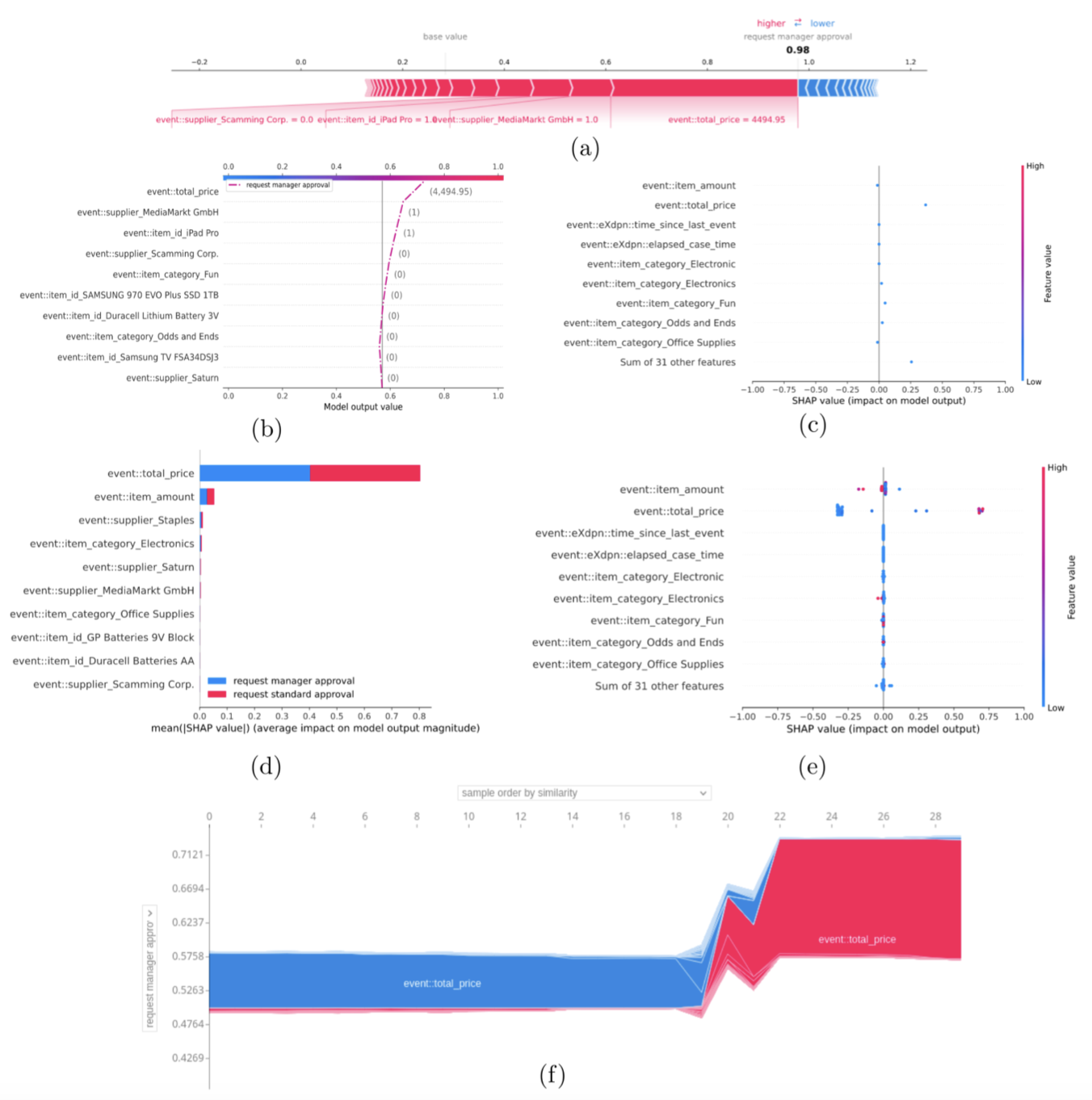
- Uses Shapley Additive Explanations (SHAP) to deliver local explanations per running instance and global explanations by aggregating SHAP values across instances.
- An open-source web application,
eXdpn(GitHubaarkue/eXdpn), that discovers Petri nets with the inductive miner, builds situation tables from case, event, and performance features, trains four model families, and visualizes explanations. - An evaluation protocol combining 5-fold cross-validated F1 scores on BPI Challenge 2012 and 2019 with a controlled CPN Tools simulation of a Purchase-to-Pay process whose decision logic is known.
Key findings
- On ten decision points from BPI Challenge 2012 (offers) and 2019 (filtered), XGBoost reaches a top-two F1 score at eight points and support vector machines at six, while the decision tree does so only twice (p16 and p11).
- Gains are largest on harder decision points: at p4 and p6 of BPI Challenge 2012 the decision tree scores 0.6888 and 0.7545 F1, versus 0.725 and 0.8048 for the neural network.
- On easy decision points all algorithms converge (for example 0.9612 for all methods at p16 and up to 1.0000 at p11), so the advantage of advanced models is small there.
- In the simulated Purchase-to-Pay process, the four most impactful SHAP features for the customs-hold decision (EU or non-EU origin, total price, number of items) match the decision logic coded in the simulation, indicating reliable explanations.
- SHAP explanations are less expressive than the logical rules produced by tree-based decision mining, and the approach leaves feature definition for situation tables and the link from explanations to concrete actions to future work.