Abstract
As business environments become more dynamic and complex, it becomes indispensable for organizations to objectively analyze business processes, monitor the existing and potential operational frictions, and take proactive actions to mitigate risks and improve performances. Process mining provides techniques to extract insightful knowledge of business processes from event data collected during the execution of the processes. Besides, various approaches have been suggested to support the real-time (predictive) monitoring of the process-related problems. However, the link between the insights from the continuous monitoring and the concrete management actions for the actual process improvement is missing. Action-oriented process mining aims at connecting the knowledge extracted from event data to actions. In this work, we propose a general framework for action-oriented process mining covering the continuous monitoring of operational processes and the automated execution of management actions. Based on the framework, we suggest a cube-based action engine where actions are generated by analyzing monitoring results in a multi-dimensional way. The framework is implemented as a ProM plug-in and evaluated by conducting experiments on both artificial and real-life information systems.
Practical problem
Companies run standardized processes such as order-to-cash, yet real executions produce thousands of variants and recurring frictions: late deliveries, slow quotations, orders changed after confirmation. Process mining makes these problems visible, and monitoring techniques detect or predict them in near real time, but the step from a detected problem to a management action is left to ad-hoc human judgment, and commercial action engines generate actions without a systematic method. Process owners therefore watch dashboards full of violations while the actual interventions, such as reprioritizing an order, alerting a manager or adding a resource, stay manual, slow and inconsistent. What is missing is a structured way to turn a continuous stream of monitoring results into actions that the underlying information system executes automatically.
Research questions
- How can the continuous monitoring of operational processes and the automated execution of management actions be connected in one general framework?
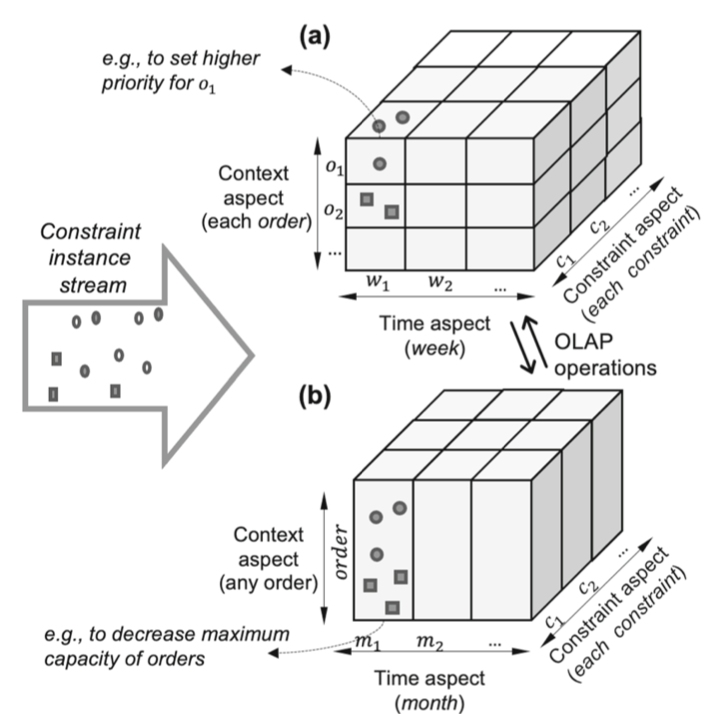
- How can a stream of constraint violations be structured and analysed at suitable abstraction levels so that the needed management actions are generated?
- Do the monitor and the action engine detect violations and generate transactions correctly, and does executing those transactions in a real information system improve the process?
Contributions
- A general framework for action-oriented process mining with a constraint monitor that turns an event stream into a constraint instance stream and an action engine that turns it into an action instance stream.
- Formal definitions of constraints, time moments, constraint instances, transactions, actions and action instances over object-centric event data in which multiple object types interact.
- A cube-based action engine: constraint cubes with constraint, context and time dimensions, OLAP (online analytical processing) operations such as slice, dice, roll-up and drill-down, assessment functions and transaction mappings.
- An open-source
ProMplug-in,ActionOrientedProcessMining, that reads JSON-OCEL (Object-Centric Event Log) streams and defines constraints and actions with a Constraint Formula Language and an Action Formula Language; manual and data on GitHub. - An evaluation protocol that drives a real SAP ERP (enterprise resource planning) ECC 6.0 system with CPN Tools-simulated automation logs and executes generated actions through a dedicated gateway.
Key findings
- On the artificial order-handling system (16 resources, 72-hour delivery agreement), the monitor detects every late order at each 24-hour check and the engine issues the specified priority raises and manager notifications for the 40 inspected orders.
- Over 30 simulated days the number of orders violating the 72-hour agreement is lower at every point in time when the generated actions are applied than when they are not.
- In the SAP order-to-cash process (151 inquiries), alerting sales managers and adding a temporary resource when late responses exceed 10 percent lowers mean response time from 30.10 hours (2 Dec.) to 23.35 hours (7 Dec.) and its standard deviation from 17.88 (4 Dec.) to 1.25.
- Notifying customers and inserting a sales-manager approval step cut orders with multiple post-confirmation changes from 18 percent to 4 of 53 changed orders (7.5 percent).
- The framework is not evaluated with real human participants, has no feedback mechanism to catch conflicting or counter-productive actions, and reduces constraint outcomes to a binary OK/NOK.