Abstract
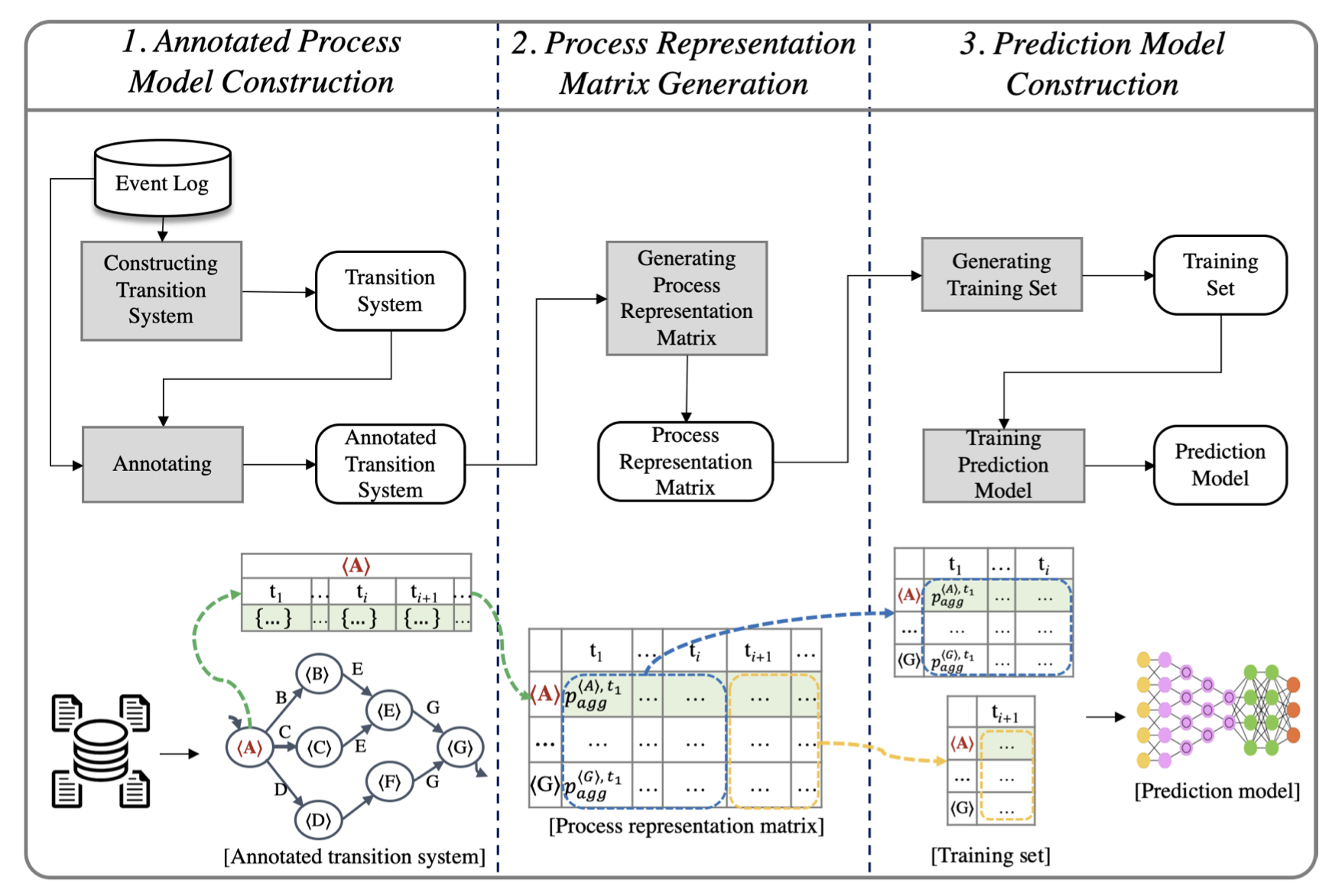
Online operational support is gaining increasing interest due to the availability of real-time data and sufficient computing power, such as predictive business process monitoring. Predictive business process monitoring aims at providing timely information that enables proactive and corrective actions to improve process enactments and mitigate risks. There are a handful of research works focusing on the predictions at the instance level. However, it is more practical to predict the performance of processes at the process model level and detect potential weaknesses in the process to facilitate the proactive actions that will improve the process execution. Thus, in this paper, we propose a novel method to predict the future performances of a business process at the process model level. More in detail, we construct an annotated transition system and generate a process representation matrix from it. Based on the process representation matrix, we build performance prediction models using deep neural networks that consider both spatial and temporal dependencies present in the underlying business process. To validate the proposed method, we performed case studies on three real-life logs.
Practical problem
Operations managers in hospitals, banks, and service desks want to know where their process will clog up next so they can add staff or reroute work before delays build. Predictive monitoring tools exist, but they forecast one running case at a time (for example the remaining time of a single loan application), and a manager of a process with thousands of concurrent cases cannot act on thousands of individual alerts. What is missing is a forecast at the level of the process model itself: which activities and hand-overs will have long waiting or processing times in the next hour or next day. Simple per-activity statistics ignore the fact that a delay in one step propagates to the next, so they miss exactly the cascading bottlenecks managers care about.
Research questions
- How can the future performance of a business process be predicted at the process model level, rather than per instance, from historical event data?
- Do deep neural networks that capture both the spatial structure of the process model and its temporal evolution predict activity and transition performance more accurately than per-location statistical models or similarity search?
Contributions
- Formalizes an annotated transition system in which states and transitions carry multisets of waiting, processing, and sojourn time measurements obtained by replaying the event log.
- Two process representation matrices: a two-dimensional matrix (model elements by time windows) and a three-dimensional matrix (from-state by to-state by time window) encoding directly-follows topology.
- Three prediction models adapted from traffic congestion forecasting: a convolutional neural network (CNN), a long short-term memory network (LSTM), and a long-term recurrent convolutional network (LRCN).
- Two baseline families for model-level performance prediction: per-element statistical regressors (linear regression, random forest, support vector regression) and nearest-snapshot search with Euclidean, Chebyshev, and cosine distance.
- A Python implementation with source code and supplementary material released on GitHub (
gyunamister/performance_prediction), evaluated on three real-life logs.
Key findings
- On an emergency-department log (459,700 events, 29,871 patients) LRCN gives the lowest error in all four tasks; for 1-hour-ahead state sojourn time its mean absolute error is 0.26 h versus 0.36 h for the best baseline (support vector regression).
- On BPI Challenge 2012 (262,200 events, 13,087 cases), predicting 6-hour-ahead processing time from 144 hours of history, CNN and LRCN reach 0.44 h state and 0.19 h transition mean absolute error, beating all statistical and search-based baselines.
- On the Helpdesk log (8,988 events, 2,542 cases), predicting 5 days ahead from 30 days of history, LRCN attains the lowest state error (1.71 days versus 2.24 days for support vector regression).
- Encoding the directly-follows topology in the three-dimensional matrix is what makes LRCN stable: as the transition-system horizon grows on BPI Challenge 2012, LRCN improves most, at the cost of longer training and higher overfitting risk.
- Deep models do not win everywhere: LSTM falls behind baselines for short-term prediction from only 12 hours of history, CNN and LSTM trail statistical models for 3-hour-ahead transition prediction, and Euclidean search is best for Helpdesk transitions.